August 17, 2026
How Precision Sheet Metal Fabrication Is Changing with Automation and Smart Manufacturing
Introduction
Precision sheet metal fabrication used to follow a very clear sequence: cut the sheet, punch the holes, bend it, weld the parts together, grind the welds, and move the finished component to the next assembly stage.
Those basic processes have not disappeared. What has changed is how they are performed and connected.
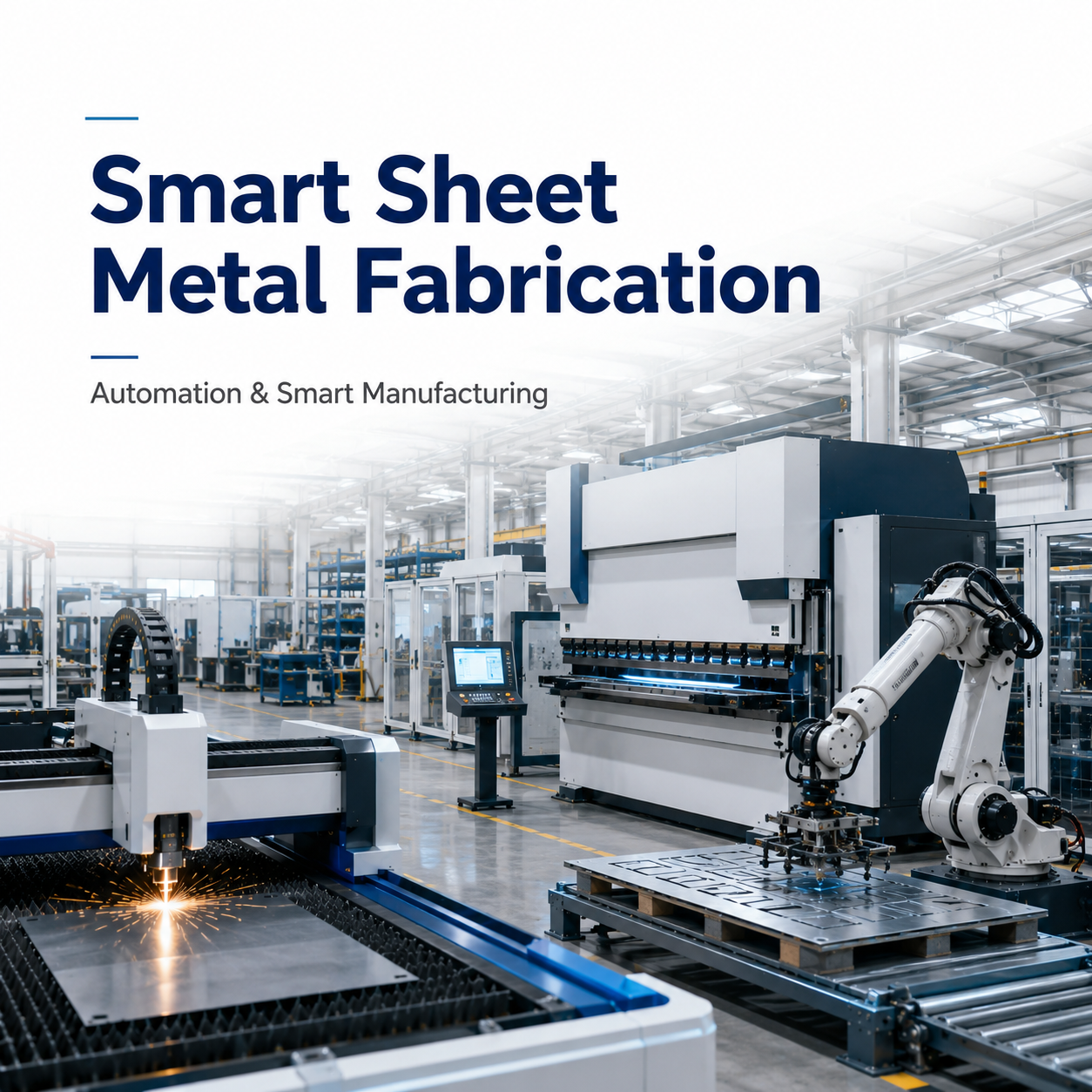
Modern Precision Sheet Metal Fabrication is moving from standalone, operator-dependent equipment toward fiber laser cutting, servo-controlled bending, robotic welding, automated material handling, digital inspection, and production systems connected through MES and ERP software.
This shift is being driven by practical manufacturing pressures. Customers want more product variants, shorter lead times, tighter repeatability, and smaller production batches. At the same time, industries such as industrial automation, EV equipment, medical devices, data infrastructure, and communications increasingly require sheet metal parts that perform as functional components rather than simple covers.
The result is a different production model: fewer isolated operations, more connected processes, and greater use of automation where it creates real value.
Table of Contents
· Why Precision Sheet Metal Processing Is Changing
· Fiber Laser Cutting Replaces More Traditional Cutting Work
· Servo and Robotic Bending Improve Repeatability
· Welding Is Becoming More Automated
· Secondary Processes Are Joining the Automated Workflow
· Smart Material Handling Connects Production
· MES and ERP Bring Data into the Workshop
· Traditional vs Modern Sheet Metal Manufacturing
· What Smart Manufacturing Means for Buyers
· Frequently Asked Questions
· Conclusion
Why Precision Sheet Metal Processing Is Changing
Traditional sheet metal production relies heavily on skilled operators.
An experienced worker knows how a particular material behaves during bending. A welder understands how to control heat and distortion. Operators manually move parts from cutting to bending, then to welding, grinding, and inspection.
This model can produce excellent results, but it becomes harder to scale when production becomes more complex.
Modern manufacturers increasingly deal with:
· More part numbers
· Smaller batches
· Frequent drawing revisions
· Shorter delivery schedules
· Higher repeatability requirements
· Greater pressure on labor efficiency
Digital equipment helps move some operator knowledge into machine programs, sensors, compensation systems, and production software.
The operator is not disappearing. The role is changing.
Instead of manually controlling every movement, skilled employees increasingly focus on setup, process optimization, programming, inspection, and troubleshooting.
Fiber Laser Cutting Replaces More Traditional Cutting Work
Cutting has seen one of the clearest technology shifts.
Traditional sheet metal workshops commonly used:
· Shearing machines
· CNC punching
· Plasma cutting
These processes are still useful, but fiber laser cutting has become increasingly important because it combines speed with digital flexibility.
A laser cutting machine can produce:
· Complex contours
· Mounting holes
· Slots
· Ventilation patterns
· Irregular profiles
· Custom blanks
without requiring dedicated cutting tooling for every design.
That makes laser cutting especially useful for custom manufacturing and high-mix production.
If a customer changes a drawing, the cutting program can often be updated directly from the new digital file. There is no need to redesign a hard cutting tool for every revision.
Modern laser systems can also be combined with:
· Automatic sheet loading
· Automatic unloading
· Sheet storage towers
· Part sorting
· Scrap handling
This changes laser cutting from an isolated machine into the first stage of an automated production flow.
For manufacturers handling many different custom components, that flexibility is often just as important as cutting speed.
Servo and Robotic Bending Improve Repeatability
Bending has traditionally depended heavily on operator experience.
Material thickness, strength, tooling, bend radius, and springback all influence the finished angle.
Springback is particularly important because metal tends to recover slightly after the bending force is removed.
Different materials behave differently, which means the machine cannot simply move to a nominal angle and assume every part will finish exactly the same way.
Modern servo-controlled bending systems improve this process through more precise axis control and compensation functions.
Compared with traditional hydraulic systems, modern servo equipment can provide:
· More accurate positioning
· Faster response
· Better repeatability
· Lower energy consumption in suitable applications
· Easier integration with automation
Robotic bending takes the process another step.
A robot can pick up the blank, position it at the press brake, support it during bending, reposition it for additional bends, and remove the completed component.
This becomes particularly useful for repetitive parts, larger panels, and production where manual handling creates inconsistency or fatigue.
The main advantage is not simply reducing labor.
It is making repeated bending operations more predictable.
Welding Is Becoming More Automated
Welding remains one of the most important sheet metal processes.
Traditional TIG, MIG/MAG, and resistance welding are still widely used, but robotic welding is becoming more common where the work is repetitive and the weld path is predictable.
Robotic welding can improve:
· Repeatability
· Weld-position consistency
· Production stability
· Operator safety
One challenge is that fabricated sheet metal parts are not always positioned perfectly.
Small dimensional differences can move the real weld seam away from its programmed location.
This is where vision systems and seam tracking become useful.
Sensors can identify the actual seam and allow the welding system to adjust the robot path.
Laser welding is also gaining attention in precision applications.
Because laser energy is concentrated in a smaller area, it can reduce the heat-affected zone and limit distortion in suitable products.
It can also reduce the amount of post-weld grinding required in some applications.
However, laser welding is not automatically better than traditional welding.
Material type, joint design, gap control, thickness, equipment cost, and production quantity still determine which process makes sense.
The broader trend is that manufacturers now have more joining options and can select the process according to the actual product.
Secondary Processes Are Joining the Automated Workflow
Cutting, bending, and welding receive most of the attention, but secondary processes can consume a large amount of production time.
These may include:
· Deburring
· Edge rounding
· Weld grinding
· Surface preparation
· Sheet leveling
Many of these tasks were traditionally performed manually.
Automation is now entering these areas as well.
Automatic deburring equipment can process cut edges more consistently. Robotic grinding systems can handle repetitive weld-cleaning tasks. Leveling machines can improve flatness before parts move into later operations.
This matters because a production line is only as fast as its slowest stage.
There is little benefit in cutting parts extremely quickly if they spend hours waiting for manual deburring or grinding.
Smart manufacturing therefore focuses on the complete workflow rather than one high-speed machine.
Smart Material Handling Connects Production
Automating individual machines only solves part of the problem.
The material still has to move between them.
Traditional factories rely heavily on forklifts, carts, and manual handling.
Modern flexible sheet metal production increasingly uses:
· Automatic storage towers
· Loading systems
· Unloading systems
· AGVs
· Automated part sorting
Raw sheet material can be stored digitally and delivered to the correct machine when required.
After cutting, parts can move toward bending, welding, or other operations with less manual intervention.
This helps reduce:
· Waiting time
· Manual transport
· Work-in-process inventory
· Part identification errors
The result is a production system where machines are not simply automated individually—they are connected.
MES and ERP Bring Data into the Workshop
The physical movement of metal is only one half of smart manufacturing.
The other half is information.
ERP systems typically manage wider business information such as:
· Customer orders
· Materials
· Purchasing
· Inventory
· Production scheduling
MES systems work closer to the production floor.
They can help manage:
· Work orders
· Machine status
· Production progress
· Process instructions
· Traceability
· Quality records
This becomes particularly important for custom sheet metal manufacturers handling many part numbers at the same time.
A connected system can make it easier to know:
· Which drawing revision is current
· Which parts have already been cut
· Which order is waiting for bending
· Which process is creating a bottleneck
That visibility helps reduce confusion and supports more flexible production.
Smart manufacturing is therefore not only about faster machines.
It is also about better information flow.
Traditional vs Modern Sheet Metal Manufacturing
Manufacturing Area | Traditional Approach | Modern Direction |
Cutting | Shearing, punching, standalone cutting | Fiber laser cutting with automation |
Bending | Hydraulic press brake and operator experience | Servo control and robotic bending |
Welding | Manual TIG/MIG welding | Robotic and vision-guided welding |
Deburring | Mainly manual | Automated deburring and grinding |
Material Movement | Forklifts and manual handling | Storage systems and AGVs |
Production Control | Paper-based scheduling | MES/ERP-connected production |
Production Model | Separate workstations | Flexible integrated production |
Operator Role | Direct manual processing | Setup, monitoring and optimization |
This does not mean traditional equipment is obsolete.
A manual welding station may still be the most efficient option for a one-off prototype.
A conventional press brake can still produce excellent components.
Automation creates value when production volume, complexity, repeatability, or labor requirements justify it.
The correct manufacturing strategy is not “automate everything.”
It is “automate the processes where automation improves the overall system.”
Real Industry Direction: Integrated Cutting and Bending
One of the clearest examples of this transition is the integration of laser cutting, automatic storage, and automated bending.
Instead of treating each process separately, a connected production system can move material through several stages with much less manual handling.
Raw sheets are retrieved from storage.
They are delivered automatically to the laser.
After cutting, parts are sorted and sent toward bending.
The bending process can then be completed within the same connected production environment.
Why is this important?
Because many fabrication delays do not happen while the machine is cutting or bending.
They happen between processes.
Parts wait for transport.
Operators search for the correct batch.
Machines remain idle because the next material has not arrived.
Integrated production reduces those gaps.
This shows that the future of Automated Sheet Metal Fabrication is not just about faster individual machines.
It is about reducing wasted time between them.
Combined and Hybrid Processes Are Expanding
Another development is the use of combined processing.
Punch-laser systems are one example.
Punching can efficiently produce:
· Repeated holes
· Louvers
· Standard formed features
Laser cutting is better suited to complex external contours and irregular shapes.
Combining both processes allows the manufacturer to select the most efficient method for each feature while reducing repeated handling.
Hybrid manufacturing may also become more important.
For advanced equipment, one assembly may combine:
· Sheet metal structures
· CNC-machined interfaces
· Welded frames
· Specialized additively manufactured components
3D metal printing is unlikely to replace economical sheet fabrication for ordinary cabinets and frames, but it can complement traditional processes where complex geometry is difficult to produce conventionally.
The direction is toward using multiple technologies together rather than expecting one process to do everything.
What Smart Manufacturing Means for Buyers
From a buyer's perspective, automation should create practical value.
A modern factory may look impressive, but the important question is what the technology improves.
Better Repeatability
Digital positioning, compensation, and robotic handling can reduce variation caused by repeated manual operations.
Faster Response to Design Changes
Laser cutting and digitally programmed bending can support drawing revisions more efficiently than fixed hard tooling in many applications.
Better Production Visibility
Connected manufacturing systems make it easier to track orders and process progress.
More Stable Capacity
Automation can reduce dependence on continuous manual handling for repetitive production.
Better High-Mix Production
Flexible automation helps manufacturers move between different product types while keeping production organized.
These advantages are especially relevant for customers developing customized industrial equipment.
What This Means for Hongdingtian
Hongdingtian (Suzhou) Intelligent Technology Co., Ltd. works across precision sheet metal fabrication, precision machining, automation equipment manufacturing, and process development.
Its production capability includes high-power laser cutting, CNC tube cutting, CNC bending, machining, drilling, tapping, and related manufacturing processes.
This combination reflects the broader direction of the industry.
Modern customers increasingly need more than one fabricated metal panel.
A project may require:
· Laser-cut sheet metal
· Bent cabinets
· Welded frames
· Machined interfaces
· Equipment enclosures
· Complete non-standard structures
Connecting these processes allows precision sheet metal fabrication to become part of a larger equipment manufacturing solution rather than remain an isolated workshop service.
Frequently Asked Questions
How is precision sheet metal fabrication changing?
The industry is moving from standalone, operator-dependent equipment toward fiber laser cutting, servo bending, robotic welding, automated material handling, digital inspection, and MES/ERP-connected production.
Will automation completely replace manual sheet metal work?
No. Manual processes remain valuable for prototypes, highly variable products, complex assembly, and jobs where automation is not economically justified.
Why is robotic bending becoming more common?
Robotic bending can improve repeatability, reduce manual handling, and make repetitive bend sequences easier to control during longer production runs.
What is a smart sheet metal production line?
It is a production system where storage, cutting, bending, welding, material handling, inspection, and production data are increasingly connected rather than operated as separate isolated processes.
Conclusion
The biggest change in precision sheet metal fabrication is not one new machine.
It is the way the entire production system is being connected.
Fiber laser cutting is becoming linked with automatic storage and loading. Bending is moving toward servo control and robotic handling. Welding increasingly uses robotics and vision systems. Deburring and grinding are becoming automated. MES and ERP systems connect manufacturing information with customer orders and production planning.
The familiar processes—cutting, bending, welding, and finishing—are still there.
What is changing is how intelligently they work together.
For buyers, this means evaluating a sheet metal supplier should go beyond checking whether the factory owns a laser cutter or press brake.
The stronger question is whether cutting, bending, welding, machining, finishing, material handling, inspection, and production control can operate as a coordinated system.
Hongdingtian (Suzhou) Intelligent Technology Co., Ltd. combines precision sheet metal fabrication with machining and automation equipment manufacturing, positioning its capabilities within this broader shift toward connected production.
The next stage of Precision Sheet Metal Fabrication will not be defined only by faster equipment.
It will be defined by how effectively machines, people, materials, and production data work together to deliver consistent parts with shorter lead times and greater manufacturing flexibility.