August 7, 2026
How Raw Material Deformation Affects Precision Sheet Metal Fabrication
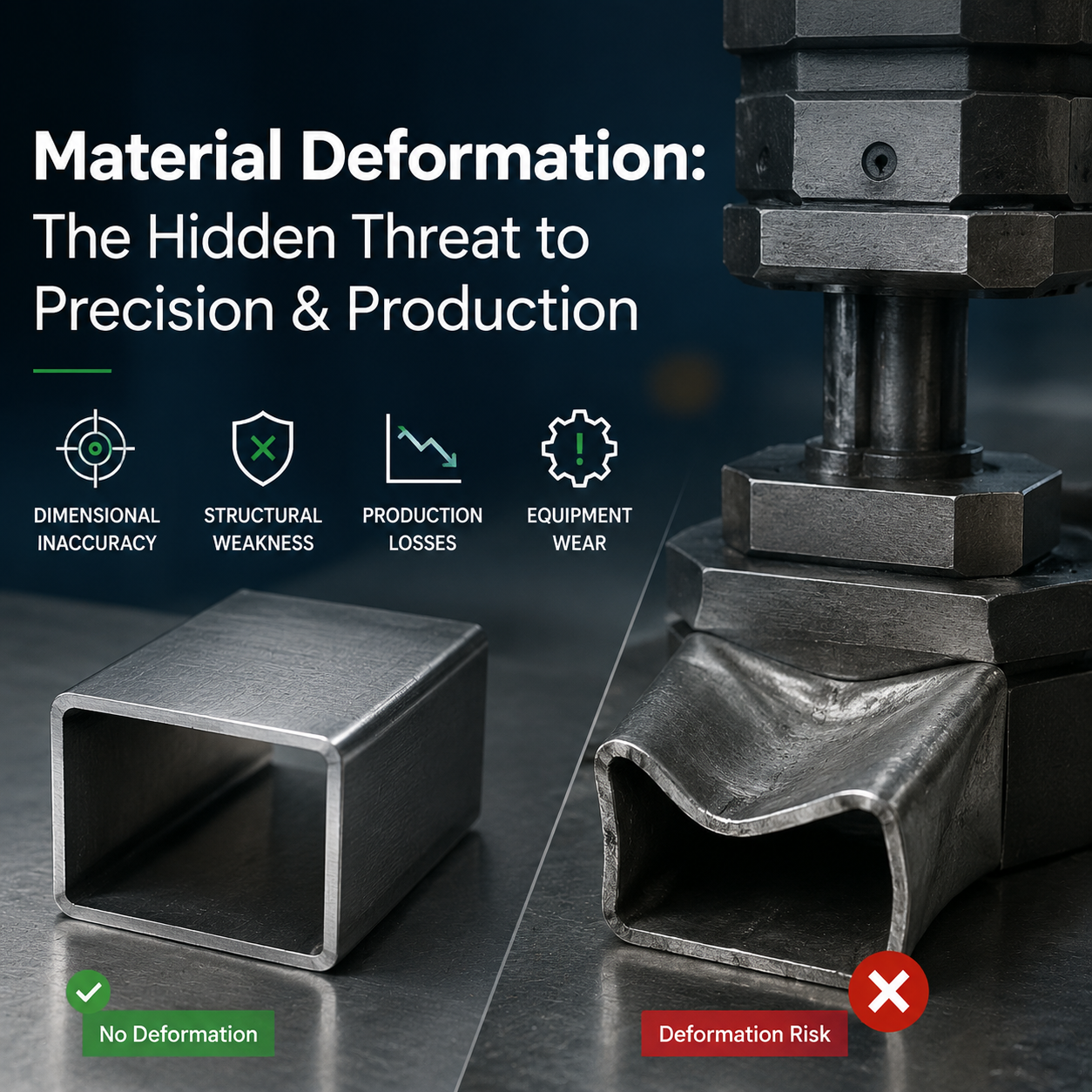
Raw material quality has a direct influence on every stage of precision sheet metal fabrication. Even when a factory uses advanced laser cutting, CNC punching, bending, welding, and inspection equipment, deformed sheet metal can still cause dimensional errors, unstable processing, additional rework, and assembly problems.
Sheet deformation may appear as bowing, edge waves, center buckling, twisting, camber, or general surface unevenness. Some defects are immediately visible, while others only become obvious after the sheet has been cut and its internal stress begins to release.
For manufacturers producing electrical cabinets, equipment enclosures, automotive brackets, laboratory equipment, ventilation components, or precision industrial assemblies, these problems cannot be treated as minor cosmetic issues. A sheet that is not flat can affect cutting accuracy, bending consistency, welding alignment, coating quality, and final assembly.
Understanding where deformation comes from and controlling it before production are therefore essential parts of a reliable sheet metal quality system.
Table of Contents
· What Causes Sheet Metal Raw Material Deformation?
· Common Types of Sheet Deformation
· How Deformation Affects Laser Cutting and CNC Punching
· Residual Stress and Post-Cutting Distortion
· Effects on Bending, Welding, and Assembly
· The Hidden Cost of Using Deformed Sheet Metal
· How Manufacturers Can Prevent Material Deformation
· HDT’s Approach to Precision Sheet Metal Fabrication
· Frequently Asked Questions
· SEO Metadata
What Causes Sheet Metal Raw Material Deformation?
Sheet metal deformation can begin long before the material enters a fabrication workshop.
Rolling mills control thickness, temperature, tension, cooling rate, and roll alignment during production. When these conditions are not properly controlled, the finished coil or sheet may contain uneven residual stress. The material may look acceptable while it remains in a coil or stack, but it can move after cutting.
Storage and transportation can create additional problems. Excessive stacking pressure, unsupported sheet edges, uneven pallets, unsuitable racking, or long-term storage on an unlevel surface may gradually change the shape of the material.
Improper lifting is another common cause. Long or thin sheets can bend under their own weight when they are lifted from only one point. Forklift blades, chains, or hooks may also create concentrated pressure that leaves permanent dents or bends.
Typical causes include:
· Uneven rolling or cooling during steel production
· Residual stress from coil processing
· Excessive pressure during stacking
· Unsupported storage or uneven racks
· Incorrect forklift or crane handling
· Improper lifting of large, thin sheets
· Impact damage during loading and unloading
· Temperature changes during storage or processing
Cold-rolled steel generally has a smoother surface and tighter dimensional expectations, so deformation can become especially noticeable in precision parts. Hot-rolled material may have lower cosmetic expectations, but its flatness still matters when it is used for frames, machine structures, or welded assemblies.
Common Types of Sheet Deformation
Different deformation patterns create different manufacturing risks.
Deformation Type | Typical Appearance | Possible Processing Problem |
Bowing | Sheet curves along its length or width | Poor contact with the cutting table |
Edge Wave | One or both edges appear wavy | Unstable positioning and bending variation |
Center Buckle | Center area rises while edges remain lower | Laser head clearance and clamping problems |
Twist | Corners do not remain in one plane | Incorrect fixture positioning |
Camber | Sheet edge curves sideways | Nesting and dimensional errors |
Local Denting | Small depressed or raised areas | Surface and assembly defects |
A sheet does not need to be severely damaged to create problems. In precision work, even a small amount of unevenness may influence the location of holes, slots, bends, or mating surfaces.
The acceptable condition should therefore be determined by the drawing, product function, applicable material standard, and final assembly tolerance.
How Deformation Affects Laser Cutting and CNC Punching
Laser cutting systems depend on stable sheet positioning and controlled distance between the cutting head and the material surface.
Modern equipment can compensate for small height variations, but heavily deformed sheet may still create several risks. The material may not sit correctly on the cutting bed, the cutting head may need to follow excessive height changes, and raised areas may increase the risk of collision.
Unstable positioning can lead to:
· Irregular cutting edges
· Dimensional variation
· Incomplete cuts
· Incorrect hole positions
· Increased slag or heat marks
· Machine interruption
Deformation also affects CNC punching. A sheet that cannot remain flat may move during clamping or indexing. Hole patterns and external profiles may no longer match the programmed coordinates.
Material utilization can also decline. Nesting software assumes that the usable sheet has predictable dimensions and geometry. If the sheet has severe camber or damaged edges, more material must be removed from the nesting area, increasing scrap.
For high-precision components, the resulting error may continue into later operations. A small cutting deviation can become a larger assembly problem after several bends and welded joints have been added.
Residual Stress and Post-Cutting Distortion
One of the most difficult problems is residual stress inside the material.
During rolling, leveling, cooling, slitting, and coil handling, different areas of the sheet may be stretched or compressed. The sheet remains in an apparently stable condition because these internal forces are balanced.
Cutting removes part of that balance.
Once the surrounding material is separated, the internal stress can release. Long, narrow parts may curve. Thin frames may twist. Large panels with asymmetric openings may move after they are removed from the cutting table.
This is why a sheet can appear flat before cutting but produce distorted components afterward.
The risk may be higher when a part has:
· Long and narrow geometry
· Uneven material distribution
· Large openings on one side
· Dense cutting in a local area
· Thin walls around heavy sections
· High heat input during cutting or welding
A practical process plan may use balanced nesting, suitable cutting sequences, temporary connecting tabs, additional machining allowance, or intermediate leveling to reduce these effects.
Effects on Bending, Welding, and Assembly
Material deformation does not stop affecting the part after cutting.
During CNC press brake bending, the workpiece must be positioned accurately against the back gauge and tooling. If the blank is twisted or uneven, the operator may not obtain stable contact. Bend angle, flange length, and part geometry can then vary from one piece to another.
Residual stress may also contribute to springback. After bending, forming, tapping, embossing, or self-clinching operations, the part may continue to move as internal stress is redistributed.
Welding introduces additional heat and shrinkage. If the components already contain uncontrolled stress, the final assembly may distort more than expected.
These problems can affect:
· Bend angle consistency
· Flange length
· Hole-to-edge distance
· Press-fit and self-clinching features
· Welding fixture alignment
· Door and panel flatness
· Surface finishing appearance
· Final assembly gaps
Coating and paint curing may expose additional movement because the part is heated during the process. A panel that passed an earlier inspection may show warping after powder coating or baking.
The Hidden Cost of Using Deformed Sheet Metal
The cost of deformation is not limited to rejected material.
When defective sheet enters production, manufacturers may need to add leveling, manual straightening, trial bending, fixture adjustment, re-cutting, grinding, or rework.
Cost Area | Typical Consequence |
Additional Labor | Manual leveling, adjustment, and inspection |
Machine Time | Re-cutting or repeated bending operations |
Material Waste | Scrapped blanks and finished components |
Tooling Adjustment | Extra fixture and process modifications |
Delivery Risk | Production delays and interrupted schedules |
Assembly Problems | Poor fit between panels and components |
The later a deformation problem is discovered, the more expensive it becomes.
Rejecting or correcting a sheet during incoming inspection is usually more efficient than discovering the problem after cutting, bending, welding, finishing, and assembly.
How Manufacturers Can Prevent Material Deformation
Effective prevention begins with purchasing and incoming inspection.
1. Define Material Requirements Clearly
Purchase documents should identify the material grade, thickness, applicable standard, surface condition, coating requirement, and flatness expectations.
Terms such as “steel sheet” or “aluminum plate” are not specific enough for precision production.
2. Perform Incoming Material Inspection
Incoming sheets should be checked for:
· Material identification
· Thickness and thickness tolerance
· Surface condition
· Flatness
· Bow, twist, and camber
· Edge damage
· Rust or coating defects
The inspection method should match the tolerance level of the final product.
3. Improve Storage Conditions
Sheet material should be stored on stable, level supports. Long sheets require enough support points to prevent sagging.
Heavy stacks should not be placed on thin or sensitive material, and separators should be used when surface protection is required.
4. Use Suitable Handling Equipment
Vacuum lifters, magnetic lifting systems, spreader beams, and suitable sheet-handling devices can distribute the load more evenly.
Workers should avoid dragging sheets or lifting long panels from a single point.
5. Level Material Before Production
Roller leveling or controlled straightening can reduce visible deformation and redistribute stress before cutting.
However, leveling is not a universal repair method. Material with severe damage, cracks, or deep dents may need to be rejected.
6. Plan the Cutting Sequence
For stress-sensitive parts, cutting order can affect the final shape. Balanced cutting, suitable part orientation, and controlled heat distribution can reduce distortion.
Trial production is recommended for complex or high-tolerance components.
7. Maintain Process Traceability
Material batch information, inspection records, cutting parameters, and dimensional results should be traceable.
When deformation occurs, traceability helps the engineering team identify whether the cause came from the material, storage, cutting sequence, bending process, or welding operation.
HDT’s Approach to Precision Sheet Metal Fabrication
HDT Intelligent Technology provides precision machining and sheet metal fabrication services for aerospace, automotive, telecommunications, medical, electronics, laboratory equipment, and industrial applications.
Its manufacturing capabilities include laser cutting, CNC bending, welding, surface treatment, mechanical assembly, CNC milling, CNC turning, and process development.
For sheet metal projects, controlling raw material condition is part of maintaining stable production quality. By reviewing drawings, checking material requirements, planning cutting and bending operations, and monitoring production, the engineering team can reduce the risk of dimensional variation and downstream rework.
Customers can provide drawings, material specifications, tolerance requirements, surface treatment details, and expected order quantities for technical evaluation.
Frequently Asked Questions
Can a laser cutting machine compensate for deformed sheet metal?
Automatic height control can compensate for small surface variations, but it cannot completely solve severe bowing, twisting, or edge waves. Excessive deformation may still affect cut quality, positioning accuracy, and machine safety.
Why does sheet metal deform after it has been cut?
The material may contain residual stress from rolling, cooling, slitting, or previous handling. Cutting removes the surrounding restraint, allowing these internal forces to release and change the part geometry.
Should every deformed sheet be leveled before fabrication?
Minor deformation may be corrected through suitable leveling, but severe damage, local dents, cracks, or unstable material may require rejection. The decision should consider the product tolerance and end-use requirements.
How can buyers reduce deformation problems in custom sheet metal parts?
Buyers should define the material grade, thickness, flatness requirement, critical tolerances, surface treatment, and assembly conditions clearly in the drawing and purchasing specification.
Reduce Sheet Metal Deformation Risks Before Production
Raw material deformation can influence far more than the appearance of a metal sheet. It may affect cutting accuracy, bending consistency, welding alignment, surface finishing, and final assembly quality. Identifying flatness problems and residual stress before production helps manufacturers reduce rework, material waste, and delivery risks.
For custom sheet metal projects, early engineering communication is equally important. Buyers should provide complete drawings, material grades, sheet thicknesses, critical tolerances, surface treatment requirements, and expected order quantities whenever possible. This information allows potential manufacturing risks to be evaluated before cutting and forming begin.
HDT provides precision sheet metal fabrication, laser cutting, CNC bending, welding, surface finishing, and mechanical assembly services for customized industrial components. Contact HDT to discuss your application, request a suitable manufacturing solution, or obtain a quotation for your next sheet metal project.