August 17, 2026
Precision Sheet Metal Parts: Classification, Materials and Applications
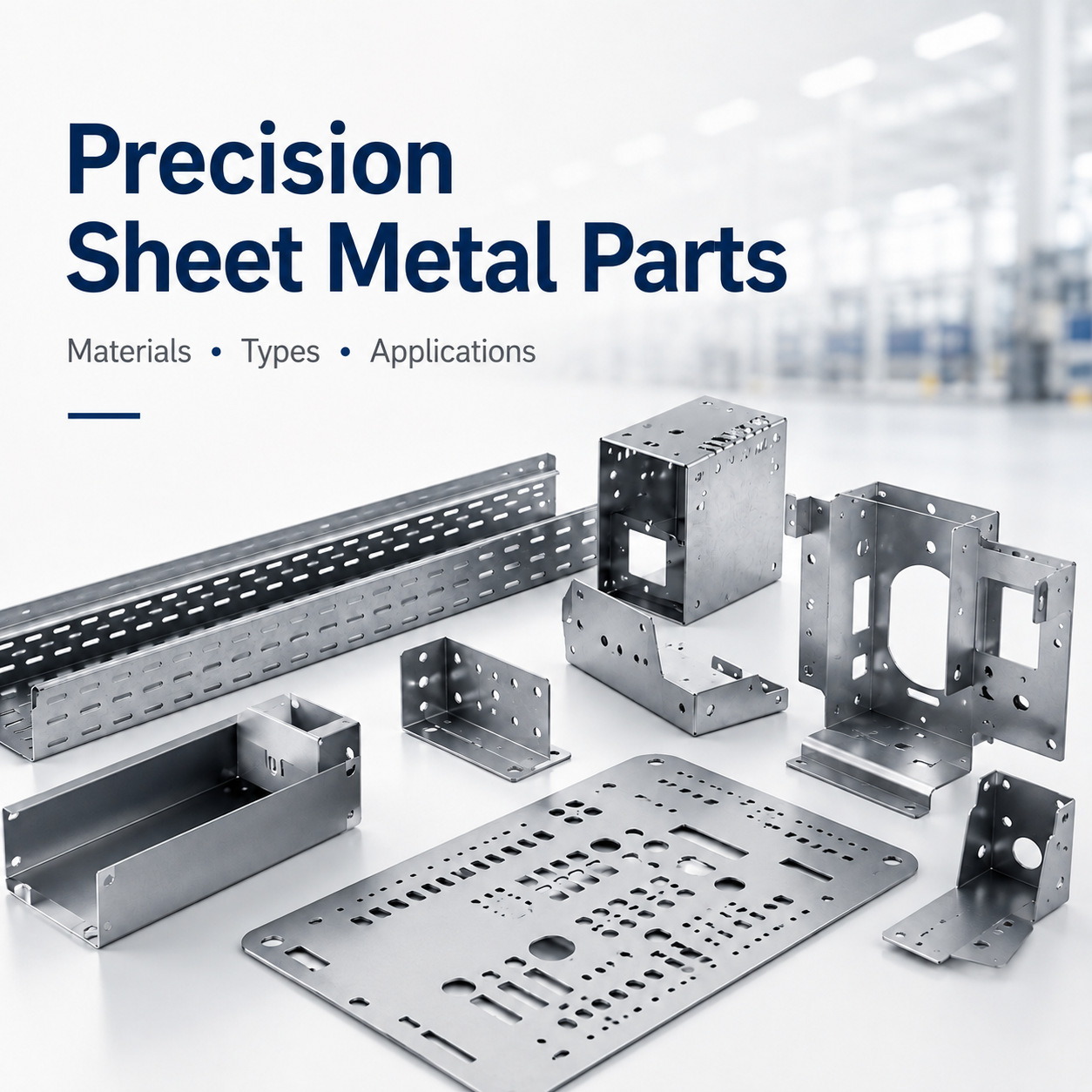
Introduction
A sheet metal part can be as simple as a bent bracket. But once that part becomes part of a server cabinet, medical machine, automation system, electric vehicle, or battery enclosure, the requirements change quickly.
Hole position affects assembly. Bend angle influences alignment. Welding can distort flatness. Material selection changes weight, strength, corrosion resistance, and thermal behavior.
That is where Precision Sheet Metal Parts differ from ordinary fabricated metal components.
Precision sheet metal fabrication normally combines processes such as laser cutting, stamping, bending, welding, drilling, machining, and surface finishing. The goal is not only to create the required shape, but also to maintain dimensional accuracy, repeatability, surface quality, and functional relationships between different features.
The global sheet metal fabrication services market was worth more than USD 22 billion in 2025, supported by demand from automotive, aerospace, electronics, industrial equipment, energy, and other manufacturing sectors.
More importantly, sheet metal parts are no longer used only as covers and housings. In many modern machines, they are becoming structural and functional components.
Table of Contents
· What Are Precision Sheet Metal Parts?
· Classification by Manufacturing Process
· Classification by Material
· Common Precision Sheet Metal Materials Compared
· Automotive and Electric Vehicle Applications
· Aerospace and Advanced Mobility
· AI Data Centers and Communication Equipment
· Renewable Energy and Energy Storage
· Medical Equipment
· Electronics and Industrial Automation
· Why Precision Requirements Are Increasing
· Frequently Asked Questions
· Conclusion
What Are Precision Sheet Metal Parts?
Precision sheet metal parts are metal components manufactured from sheet material through controlled cutting, forming, bending, welding, machining, and finishing processes.
Compared with general sheet metal fabrication, precision work places greater attention on:
· Hole position
· Bend location and angle
· Flatness
· Parallelism
· Dimensional accuracy
· Surface quality
· Weld distortion
· Assembly interfaces
· Repeatability between batches
These requirements become especially important when the component has to interact with other mechanical or electrical parts.
A small dimensional difference in a decorative cover may not matter much. The same difference in a sensor bracket, machine frame, or equipment cabinet can create installation or alignment problems.
Precision sheet metal parts can be classified in two useful ways: by manufacturing process and by material.
Classification by Manufacturing Process
Stamped Sheet Metal Parts
Stamping uses a press and tooling to cut or form metal sheet.
Typical stamped parts include:
· Automotive brackets
· Reinforcement plates
· Clips
· Covers
· Electrical hardware
· Appliance components
Stamping is particularly suitable for stable, high-volume production.
Once the tooling has been developed, parts can be produced quickly and consistently. The trade-off is the initial mold or die cost, which makes stamping less attractive for prototypes or products with frequent design changes.
For buyers, the important question is whether production volume is high enough to justify the tooling investment.
Laser-Cut Sheet Metal Parts
Laser cutting is one of the most flexible processes used in modern precision sheet metal fabrication.
It can create:
· Complex profiles
· Holes
· Slots
· Ventilation patterns
· Custom blanks
· Irregular shapes
without requiring dedicated cutting tooling for each part.
This makes laser cutting especially suitable for customized machinery, electrical cabinets, prototypes, and low- to medium-volume orders.
Because the cutting path comes directly from digital drawings, design revisions can also be introduced relatively quickly.
For projects involving many different part numbers, that flexibility can be more valuable than the high production speed of dedicated stamping.
Precision Bent Parts
Bending transforms a flat blank into a three-dimensional component.
Common products include:
· Brackets
· Cabinets
· Frames
· Covers
· Equipment panels
· Mounting structures
Bending accuracy depends on material type, thickness, tooling, bend radius, grain direction, and springback.
Springback occurs because metal tends to recover slightly after the bending force is removed. The amount varies between materials and thicknesses.
Modern CNC and servo-controlled press brakes improve repeatability by controlling positioning and compensating for these variables.
This becomes important when several bent parts must fit together inside the same machine or cabinet.
Welded Sheet Metal Assemblies
Welding connects individual fabricated parts into larger structures.
Typical applications include:
· Machine frames
· Electrical cabinets
· Industrial housings
· Automation structures
· Equipment bases
The main precision challenge is distortion.
Welding introduces localized heat, which can cause flatness changes, angular movement, and dimensional variation.
Manufacturers control this through suitable fixtures, welding sequences, heat input, and post-weld correction. Some larger assemblies may also require machining after welding to restore accurate mounting surfaces.
For precision work, a strong weld is only part of the requirement. The finished assembly also has to remain dimensionally usable.
Classification by Material
Material selection affects how a sheet metal component performs during both manufacturing and final use.
Common materials include:
· Carbon steel
· High-strength steel
· Stainless steel
· Aluminum alloy
· Magnesium alloy
· Copper and copper alloys
The correct choice depends on strength, weight, corrosion resistance, formability, weldability, thermal properties, electrical conductivity, and cost.
Common Precision Sheet Metal Materials Compared
Material | Main Advantage | Main Consideration | Typical Applications |
Carbon Steel | Strength and cost efficiency | Usually needs corrosion protection | Machine frames, cabinets, equipment |
High-Strength Steel | High strength with weight-saving potential | More demanding forming | Automotive structural parts |
Stainless Steel | Corrosion resistance and cleanability | Higher material and processing cost | Medical and industrial equipment |
Aluminum Alloy | Lightweight and corrosion resistant | Lower stiffness than steel at equal thickness | EVs, electronics, aerospace |
Magnesium Alloy | Very low density | Specialized processing | Lightweight advanced applications |
Copper Alloy | Electrical and thermal conductivity | Higher material cost | Electrical and thermal components |
Material should follow the application.
Choosing stainless steel for every project may increase cost unnecessarily. Replacing steel with aluminum can reduce weight, but the design may need to compensate for different stiffness and forming behavior.
Automotive and Electric Vehicle Applications
Automotive manufacturing remains one of the largest users of sheet metal components.
Traditional applications include:
· Body structures
· Doors
· Roof components
· Brackets
· Reinforcements
· Mounting parts
Electric vehicles are adding new requirements.
Modern EV-related sheet metal parts can include:
· Battery enclosures
· Charging-system components
· Power-electronics housings
· Electrical cabinets
· Thermal-management structures
Lightweighting is especially important.
High-strength steels and aluminum alloys allow engineers to reduce weight while maintaining the required mechanical performance.
Global electric vehicle sales exceeded 20 million units in 2025, accounting for roughly one-quarter of new car sales worldwide.
As electrification grows, precision sheet metal demand is increasingly connected with battery systems, charging equipment, thermal control, and power electronics rather than only traditional body components.
Aerospace and Advanced Mobility
Aerospace applications place strong emphasis on weight, dimensional control, and structural reliability.
Typical precision sheet metal components include:
· Thin-wall structures
· Brackets
· Equipment housings
· Internal structural parts
· Engine-related components
Lightweight alloys such as aluminum are widely used where appropriate.
Emerging areas such as drones, electric aircraft, and advanced air mobility are creating similar requirements.
Many of these products begin with relatively small production quantities while designs are still evolving.
That makes flexible processes such as laser cutting, CNC bending, machining, and controlled welding particularly useful during development.
AI Data Centers and Communication Equipment
AI infrastructure is becoming another important application for precision sheet metal.
A modern server or communication cabinet does much more than protect electronics.
Its structure can influence:
· Airflow
· Cooling
· Cable management
· Equipment positioning
· Structural support
· Maintenance access
Global data center electricity consumption is expected to reach around 945 TWh by 2030, more than double recent levels.
That growth also means increasing demand for:
· Server racks
· Communication cabinets
· Power distribution equipment
· Cooling-system structures
· Networking enclosures
As equipment density increases, dimensional accuracy becomes more important.
Mounting rails need to align. Ventilation patterns must support airflow. Panels, doors, cables, and cooling components must fit within increasingly crowded spaces.
The cabinet is becoming part of system performance rather than simply an outer shell.
Renewable Energy and Energy Storage
Renewable energy systems also create significant demand for precision sheet metal.
Applications include:
· Energy storage cabinets
· Battery enclosures
· Inverter housings
· Electrical control cabinets
· Photovoltaic equipment
· Power distribution systems
Energy storage equipment is a good example of how sheet metal roles are changing.
The outer enclosure may contain batteries, control electronics, cooling systems, wiring, sensors, and safety devices.
The cabinet therefore needs to support structural loads while also providing ventilation, access, cable routing, and environmental protection.
That combination makes manufacturing accuracy increasingly important.
Medical Equipment
Precision sheet metal is widely used in medical and laboratory equipment.
Typical applications include:
· Diagnostic equipment housings
· Medical cabinets
· Monitoring equipment
· Laboratory systems
· Refrigeration and freezing equipment
· Equipment frames
These products may require cleanable surfaces, corrosion resistance, smooth edges, dimensional consistency, and controlled assembly.
Stainless steel is commonly selected where corrosion resistance and hygiene requirements justify it.
Hongdingtian (Suzhou) Intelligent Technology Co., Ltd. also works with larger electromechanical equipment, including medical-related freezing systems, showing how sheet metal fabrication can form part of complete equipment rather than only individual components.
Electronics and Industrial Automation
Industrial automation is another important growth area.
More than 542,000 industrial robots were installed globally in 2024, more than twice the annual installation level of a decade earlier.
Automated equipment requires a large amount of fabricated metal infrastructure, including:
· Electrical cabinets
· Machine guards
· Equipment frames
· Control panels
· Sensor brackets
· Covers
· Mounting structures
These parts often need to align with motors, sensors, pneumatic systems, and motion-control equipment.
A bracket that positions a sensor incorrectly can affect the operation of the entire machine.
This is why automation projects increasingly combine sheet metal fabrication with machining, inspection, and assembly.
Hongdingtian (Suzhou) Intelligent Technology Co., Ltd. works across precision machining, sheet metal fabrication, automation equipment design and production, and process development, which is particularly relevant when sheet metal components become part of larger non-standard equipment systems.
Why Precision Requirements Are Increasing
The biggest change in modern sheet metal manufacturing is integration.
Machines are becoming more compact while performing more functions.
Electronics need cooling.
Battery systems need structural support.
Automation equipment combines sensors, motion systems, electrical control, and mechanical protection.
As a result, the role of sheet metal is changing.
Traditional Role | Modern Precision Sheet Metal Role |
Basic cover | Functional equipment enclosure |
Simple bracket | Precision positioning component |
Cabinet | Electrical and thermal-management platform |
Fabricated frame | Equipment alignment structure |
Protective panel | Structural and functional component |
This explains why buyers increasingly evaluate sheet metal suppliers on more than cutting and bending capacity.
The complete manufacturing process matters.
A strong supplier needs to connect material selection, cutting, bending, welding, machining, finishing, inspection, and assembly around the final function of the part.
Frequently Asked Questions
What are precision sheet metal parts?
Precision sheet metal parts are metal components manufactured through controlled cutting, stamping, bending, welding, machining, and finishing processes with defined dimensional, geometric, surface, or assembly requirements.
What are the main types of precision sheet metal parts?
By process, common categories include stamped parts, laser-cut parts, bent parts, and welded assemblies. By material, they can include carbon steel, high-strength steel, stainless steel, aluminum, magnesium, and copper alloys.
Which industries use precision sheet metal fabrication?
Major applications include automotive and EVs, aerospace, industrial automation, AI data centers, telecommunications, renewable energy, energy storage, medical equipment, electronics, appliances, and general industrial machinery.
How should buyers choose a precision sheet metal supplier?
Look beyond machine quantity. Evaluate drawing understanding, cutting and bending capability, welding distortion control, machining support, inspection, surface treatment, and the ability to manufacture repeatable assemblies.
Conclusion
Precision sheet metal parts still begin as flat metal sheets, but their role in modern equipment has changed considerably.
They can become battery enclosures, server cabinets, automation frames, medical equipment housings, electrical cabinets, mounting brackets, and complete welded structures.
Their classification remains straightforward: by processes such as stamping, laser cutting, bending, and welding, and by materials such as steel, stainless steel, aluminum, and other alloys.
What has changed is the level of function expected from the final component.
Electric vehicles need lightweight structures. AI data centers need increasingly sophisticated equipment cabinets. Automation systems require precise mounting and alignment. Energy-storage equipment combines electrical, thermal, and structural requirements. Medical equipment demands reliable surfaces and controlled assembly.
For buyers, this means precision sheet metal fabrication should no longer be evaluated by cutting speed alone.
Hongdingtian (Suzhou) Intelligent Technology Co., Ltd. combines precision machining, sheet metal fabrication, and automation equipment manufacturing capabilities, allowing precision sheet metal components to be developed as both individual parts and elements within larger customized equipment.
As electrification, automation, AI infrastructure, and advanced manufacturing continue to expand, precision sheet metal will increasingly contribute directly to how machines perform—not simply how they look.